If this does not hold your interest please look in the other pages where you will find many photos of oxalis.
Why this page? Well lets start at the beginning.
Some time ago I felt that it was time to learn more about oxalis, than just how to grow them. Then the world of taxonomy shook me so badly, that it felt as I had severe concussion.
An example were a leaflet is described.
Leaf are basal, petiolate : leaflets suborbicular or very broadly obcordate, tapering cuneately to the base, lightly incised or sometimes almost entire, 1-5cm long, 1.2-5cm broad rather leathery, glabrous or sparsely pilose above, more densely so and sometimes purple below, ciliate.
Did you get that? I sure did not, not even after the many, many times I read it.
Then I started to read in botany books and the net, to learn about the terms that are used. And instead of keeping this for my self, I will like to share this information with you all.
As there is continuous change in this area, new input is very much appreciated.
DIVISION.....MAGNOLIOPHYTA
CLASS..........MAGNOLIOPSIDA
ORDER.........OXALIDALIS
FAMILY........OXALIDACEAE
GENUS.........OXALIS
Oxalis belongs to the wood sorrel family, oxalidaceae, which is estimated to consist of circa 800 species.
This makes oxalis the largest genus in the oxalidaceae family, and one of the larger genera of flowering plants.
Oxalis can be found through out the world, except for the polar areas.

~ The World Of Taxonomi
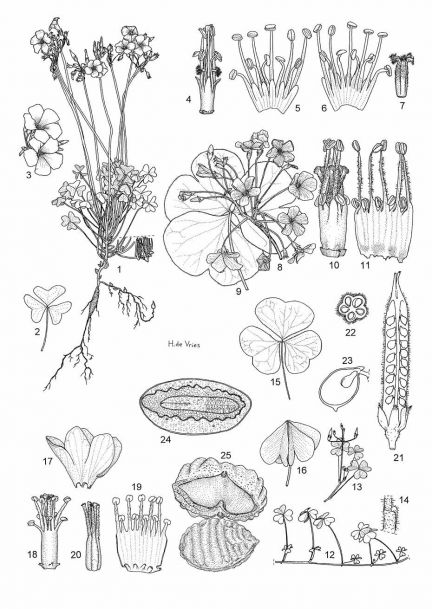
"3specs"
Nr. 1 to 7 Oxalis pes-caprae
Nr. 8 to 11 Oxalis debilis
Nr. 12 to 25 Oxalis corniculata
"Botanical illustration by Hans de Vries, courtesy of www.FlowersofChania.com"
Thank you for letting me use this marvelous print.
Oxalis can be divided in annual or perennial herbs, consisting of
-
Acaulescent species, oxalis that does not show stems/stalks above ground. They appear to have leaves growing diectely from the ground.
-
Caulescent species, oxalis that have above ground stems/stalk